As I was practicing on the drums the other day, I began to think back on how I got to be where I am musically. Both as a fan and as a musician. The memories began to flow back into my mind so fast that I decided that I better put them down on paper! So sit back and enjoy a brief overview of the musical history of yours truly.
The Beginning

I was born in 1960 in a family of musical lovers. My parents were not musicians, but my uncle "Shorty Joe Quartuccio" was a fairly popular country-western performer in the bay area beginning in the 1940's. He sang and was buddies with such legends as Hank Williams Sr., Lefty Frizzell, and the Sons of the Pioneers.
However, it was jazz that was most prominent in our house during the 60's, a well as Andy Williams, Johnny Mathis, and several other crooners of the time. Country would make it's way onto our record player from time-to-time, but it was mostly jazz and vocal standards. So that's what I was most exposed to during the first 10 years of my life.
A Taste of Honey

My very first memory of music was also my introduction to jazz as well. Herb Alpert and the Tijuana Brass (TJB) were a very popular instrumental jazz/pop crossover group throughout the 1960's that featured, in case you've never heard of them, trumpeter Herb Alpert and his six piece band. They were a unique combination of contemporary, Latin and New Orleans jazz all wrapped into one. Standards like The Lonely Bull, Tijuana Taxi, Spanish Flea, Lollipops and Roses and A Taste of Honey are still classics today. These and many other TJB tunes, mixed in with a little Dave Brubeck and Wes Montgomery, all provide the strongest music memories for me as a kid.
In the late 1960's/early 1970's, that would change to everything played on AM KLOK radio.
Ironically, my first interest in drumming came because of the TJB. I specifically remember toward the end of my first decade pulling out a couple of unsharpened pencils (they had to be unsharpened) and "shadow drumming" to many TJB tunes. It's a great thrill for me to be able to play along with them today on a real set of drums. Oh, and yes, I still like them!
KLOK in San Jose
KLOK made it's home on station AM 1170 for nearly 40 years beginning on October 13, 1946. In 1967, founder E. L. Barker sold the station to Davis Broadcasting. On August 10, 1969, KLOK increased the daytime power to its current 50,000 watts. And that's about the time I discovered the "home of the oldies but goodies" (again, thanks to my parents). KLOK became my primary music source until nearly the mid-1970s.
KLOK primarly featured music from the 50's and 60's, so that was pretty much all I was interested in during that period of time. But there were a few current pop folks, like Neil Diamond, Steely Dan, the Eagles, and Elton John, who were catching my attention as well. So thanks to that, and my sister, my music tastes slowly began to change.
Then Came Bowie

My sister, who is three years younger than I, went off in a completely different direction in music interest. She went the FM radio route and enjoyed the contemporary pop and rock stations of the time like KLIV and KOME. While I was still listening to the Everley Brothers and the Beach Boys, she was listening to Aerosmith and Kiss.
In 1975, I got wind of a song that I can safely say was solely responsible for opening my eyes to the music of the time. And it is still my all-time favorite pop/rock song: "Fame" by David Bowie. I don't remember if I overheard my sister listening to it on one of her rock stations, or accidentally caught it on the car radio, but it blew me away. Not too long after I bought my first "rock" album: David Bowie's "Young Americans". I liked it so much, that I bought his previous album "Diamond Dogs" not too long after. Rock and Roll's seed was officially planted in my brain.
Hello Guitar, Goodbye Drums
Pretty much up to the time of David Bowie, I had mostly been exposed to and interested in drums, piano and horns. Outside of Wes Montgomery, I didn't listen to a whole lot of guitar. That changed when I discovered a new genre called "country rock", and specifically a group named Lynyrd Skynyrd. I had always liked country because of my uncle, but country-rock was something new and very powerful. What particularly caught my ear was the triple threat guitar leads. I loved it. So I immediately was attracted to groups like Skynyrd, Molly Hatchet and 38 Special. And although I preferred the older southern sound of The Eagles, another favorite of mine, they went the double lead guitar route as well.

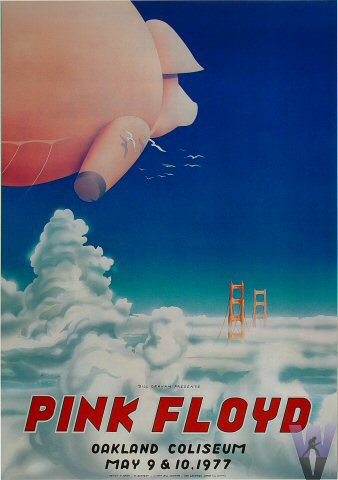
In 1977, another group began to catch my ear: Pink Floyd. I had of course been aware of their Dark Side of the Moon success in 1973, but it didn't do much for me at the time. Their new album "Animals", however, was. My sister actually owned it and I would frequently hear her playing it in her room. "Animals" featured more instrumentals than vocals, which really appealed to my old jazz side. But David Gilmour's riveting, emotionally-charged guitar playing is what really appealed to me. He's still my favorite rock guitarist.
Needless to say, that was around the time when I put down my "air drums" pencils and picked up my "air guitar" tennis racket.
Reel Me In
I was hooked. Starting with Bowie in late 1974/1975, what we now call "classic rock" became part of my music life. From the first concert I attended in the fall of 1975 (Elton John) until around 1982, I saw the likes of Chicago, ELO, Fleetwood Mac, the Doobie Brothers, The Cars, Steve Miller Band, Foreigner, Boston, Boz Scaggs, the Eagles, Jackson Browne, and Genesis. And quite a few more since then.

As you probably noticed, neither David Bowie, Lynyrd Skynyrd nor Pink Floyd appear on the list. I don't remember Bowie appearing in the bay area much, if at all, during that time (I finally did see him in the mid 1990's). I didn't get a chance to see Lynyrd Skynyrd, who was pretty much over as a band after their 1977 plane crash. Pink Floyd, however, was my biggest regret. I remember sitting at a Golden State Warriors game in early 1978 and seeing a promotion on the overhead for an upcoming Pink Floyd concert at the arena as part of their "Animals" tour. For whatever reason, I didn't or couldn't go, and thought I'd catch them the next time they were in town. Unfortunately, unbeknownst to me, there would be no next time. At least with the original group. They did tour in 1981 for "The Wall", but not in the bay area, and I didn't want to travel to the nearest show in Los Angeles. So I basically blew my chance. I did see them in 1992, but without Roger Waters. Good show, but not the same.
Don't Forget About Jazz
Despite my evolution into "classic rock", my interest in jazz never waned and continued to expand. During the 70's, two acts in particular brought me into the next generation of jazz performance: Spyra Gyra and George Benson.
Spyra Gyra, commonly identified nowadays as a "Smooth Jazz" band, was actually a bit leading-edge back in the mid-70's when they first came on to the scene. The saxophone-led group also featured numerous guitar and keyboard solos, which wasn't that common in the day. And is probably what attracted me to them. In 2015, the group launched their 40th anniversary tour which my wife and I attended when they played at Villa Montalvo in Saratoga. They are still one of the best live acts, jazz or rock, that I've ever seen. Which is probably why I've seen them five times....the most for me for a single act.
George Benson, of course, is one of the guitar kings of jazz. Back when I first started listening to him in the late 70's, his music was 80% instrumental, which I particularly enjoyed. His 1980 concert at the defunct Circle Star theater in San Carlos was not only the first live jazz concert I ever saw, but is still one of the best. One of his biggest influences was Wes Montgomery, which is a big reason why he became a favorite of mine.
Appreciating the Past
One thing I discovered during the past few years is how my music tastes. or tolerances, have changed from what they once were. In the 70's, there were several popular acts that just didn't do anything for me. Styx was one. I had no interest in high-pitched male singers like Kenny Loggins, Leo Sayer and Steve Perry. Disco? Forget about it. Hard rock groups like Led Zeppelin and Black Sabbath were too loud. The legendary Rolling Stones and The Who bored me.
Now, as I have gotten older....I mean matured....I've learned to appreciate many of them. I actually enjoy listening to Styx, Journey, the Rolling Stones and Led Zeppelin now. I even recently bought the Kenny Loggins Collection. Although I have to say I like the Loggins and Messina stuff better than Kenny Loggins' solo efforts. Still haven't been able to get into The Who, Black Sabbath, or Leo Sayer. And disco? Forget about it.
Jeff the Musician
As mentioned earlier, my career, or lack of, as a musician started in the late 1960's as an air drummer. Although....that's not completely true. Right around the same time my parents got me into trumpet lessons (thanks Herb Alpert), and after a short while when it became evident that I didn't have the lungs to consistently blow through the mouth piece of a brass instrument, I switched over to saxophone, a much easier to blow reed instrument. After playing the sax for about two years, my music teacher moved away and I discovered sports. As a result, my saxophone career came to an abrupt end.
After my air guitar career was over a few years later, I took real guitar lessons. I was in a group of about 10 people, which was probably a mistake, as I lacked the personal attention I needed to keep me motivated. After about two months of lessons, I was able to play "Jingle Bells" on two strings. It became apparent to me that at that pace, it would take months before I could play anything of substance. I just didn't have the patience for it, so I dropped out of the lessons soon after that.
Some 20 years later I started having the itch to take up the drums again. Real drums, that is. Between 1986 and 1998, however, I lived in a cottage, an apartment and a town house. None capable of housing a full drum kit. At least not if I wanted to have neighbors who liked me. And electric drum kits weren't really available commercially yet. However, in 2001, I bought a house that was secluded enough to where I could set up a drum kit in my garage. I bought a cheap eight piece sky blue beginners drum kit on eBay, rented two beginning drumming DVDs from the library, and began my drumming career at the ripe old age of 42.
Unlike the guitar, however, I seemed to pick up the drums much more quickly. After a few weeks of doing nothing but drills, I started playing along with some simple songs on CD. As I got better, I started adding more songs that featured increasingly difficult drum beats to my repertoire. Before long, I was actually playing along with the TJB tunes I had been air drumming to some 30 years early. And within a year-and-a-half I began playing with actual people.
Now, 14 years after I sat down on my drum throne for the first time, I'm about to play some songs that I'll be performing with a group of guys at my church. Ok, enough reminiscing. Time to practice!